Jigsaw Puzzles for Kids: Cognitive Benefits & Healthy Screen Time
Discover how solving jigsaw puzzles enhances child cognitive development, builds motor skills, and provides a healthy alternative to passive screen scrolling.
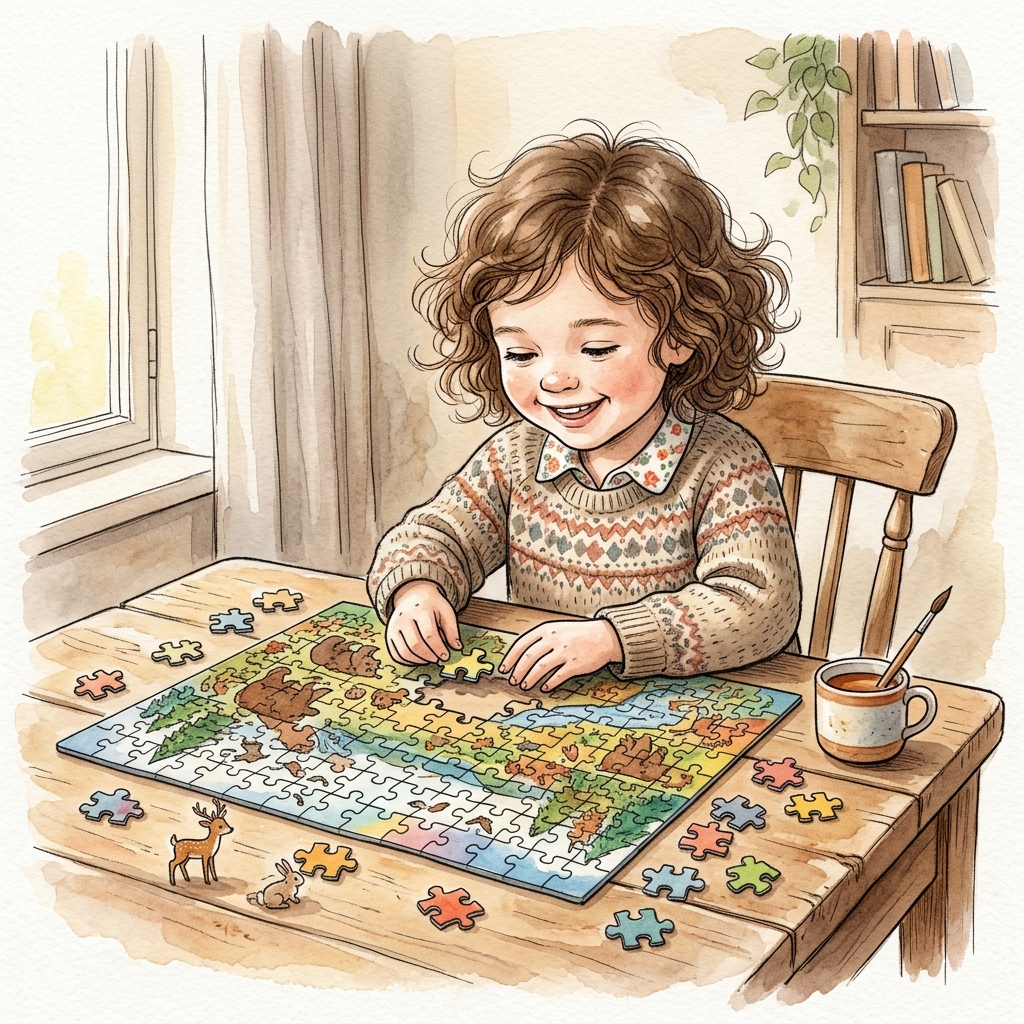
In an era dominated by mobile devices, tablets, and algorithmic video feeds, parents are facing an unprecedented challenge: managing screen time while supporting healthy brain development.
While screens themselves are not inherently harmful, the type of digital stimulation matters. Passive consumption—such as mindlessly watching short-form videos—triggers rapid dopamine spikes that can reduce attention spans, delay language skills, and lower frustration tolerance.
To support development, parents need to introduce active cognitive challenges. Jigsaw puzzles are one of the most effective, time-tested tools for child development. Whether using physical wooden blocks or engaging in interactive online play on PlayJigsaw, puzzles offer a comprehensive mental workout that builds motor skills, emotional resilience, and mathematical foundations.
1. Accelerates Fine Motor Skills and Hand-Eye Coordination
Fine motor skills involve the coordination of small muscles in movements involving the hands, fingers, and wrists. Developing these muscles is critical for future tasks like writing, drawing, using utensils, and typing.
When children play with puzzles, they must:
- Pinch and Grip: Pick up small pieces using a pincer grasp (thumb and index finger).
- Rotate and Manipulate: Turn the piece in their hand to align it with a target slot.
- Align and Press: Carefully place the piece and push it down to snap it into position.
These actions require precise hand-eye coordination. Repeated puzzle play strengthens the neural pathways between the brain and the hands, laying the physical foundation for handwriting and dexterity.
2. Builds Visual-Spatial Awareness and Geometry Foundations
How do jigsaw puzzles teach math to young children?
Jigsaw puzzles teach early geometry by training children to recognize shapes, sizes, and spatial relationships. Before a child understands formal math, they learn through puzzles how shapes fit together, how parts relate to the whole picture, and how rotating a shape alters its orientation.
This spatial reasoning is a direct predictor of future success in STEM (Science, Technology, Engineering, and Math) fields. By mentally rotating a puzzle piece to see if it fits a gap, children practice visual-spatial thinking—a skill they will later use to solve geometry equations, read blueprints, and visualize 3D models.
3. Enhances Short-Term Memory and Concentration
To solve a puzzle, a child must hold the image of the target piece in their short-term memory while scanning the remaining pool of pieces. They look for a specific color pattern, a texture, or a tab direction.
This scanning exercise builds visual memory and concentration. In a world of flashing screens and instant gratification, puzzles require sustained, quiet attention. Finishing a puzzle trains the brain to ignore distractions and focus on a single task, expanding a child's attention span and building the neural capacity for deep study.
4. Develops Emotional Resilience and Frustration Tolerance
One of the most valuable lessons a child can learn is how to handle failure. Puzzles are built on trial and error. A piece will not fit; a section will look right but be incorrect; sorting will take time.
This presents a series of minor frustrations. Working through these challenges teaches children frustration tolerance and resilience:
- The Struggle: Trying multiple configurations and failing.
- The Pivot: Adjusting strategy (e.g. searching by color instead of shape).
- The Breakthrough: Finding the correct match.
Experiencing this loop builds self-esteem and independence. The child learns that persistence leads to success, a critical psychological attitude for academic and life achievements.
5. Teaches Cognitive Problem-Solving Strategies
Solving a puzzle is not random; it requires strategic planning. Over time, children develop cognitive strategies to solve boards faster:
- Sorting: Grouping pieces by edge, color block, or textures.
- Logical Deductions: Realizing that a piece with a blue top and brown bottom must go where the sky meets the ground.
- Spatial Rotations: Recognizing that a piece needs to be rotated 90 degrees to fit.
These problem-solving skills translate directly to critical thinking, organization, and task planning in school and daily life.
Passive Entertainment vs. Active Cognitive Play
To help visualize the difference, look at how passive screen time compares to active puzzle solving in child development:
| Developmental Metric | Passive Entertainment (Video Streaming) | Active Cognitive Play (Jigsaw Puzzles) |
|---|---|---|
| Attention Mode | Fragmented, reactive (overstimulation) | Deep, sustained focus |
| Brain Wave Pattern | Passive alpha/theta waves | Active beta/gamma waves (problem-solving) |
| Motor Engagement | Static (tapping/swiping only) | Precision grasping and spatial rotation |
| Emotional Impact | High overstimulation, low patience | Builds patience, resilience, and reward |
| Math & Spatial Prep | Zero | Builds visual-spatial and geometry skills |
How to Choose Puzzles by Age Group
Choosing the right difficulty is critical. A puzzle that is too easy will bore a child; one that is too difficult will cause frustration and abandonment.
- Toddlers (Ages 2-3): Large wooden peg puzzles with 3 to 8 pieces. Focus on simple shapes, animals, and primary colors.
- Preschoolers (Ages 4-5): Frame puzzles and floor puzzles with 12 to 24 pieces. Focus on distinct illustrations with clear boundaries.
- Young Kids (Ages 6-8): 36 to 100 pieces. Digital puzzles are excellent at this stage. Our curated kids jigsaw puzzles collection features colorful, engaging watercolor illustrations of animals, toys, and storybook scenes that are perfect for this age group.
- Older Children (Ages 9+): 100 to 400 pieces. Introduce complex details and landscapes. Children can also upload dynamic images of their own drawings or pets to create personalized, highly motivating custom puzzle boards.
Tips for Parents: Integrating Puzzles into Daily Routines
- Make it Collaborative: Solve a puzzle together. This encourages communication, cooperative problem-solving, and language building as you discuss the objects in the image.
- Set Up a Digital Oasis: If your child uses a tablet, replace mindless scrolling with interactive puzzles. It turns screen time into active, brain-boosting play without the mess of physical boxes.
- Keep it Encouraging: Focus on the process rather than the speed. Celebrate their strategic adjustments and resilience when they find a difficult piece.
Ready to Train Your Brain?
Experience the therapeutic focus of jigsaw puzzles. Play our curated daily boards or upload your own photo instantly.