How to Solve Jigsaw Puzzles Fast: Step-by-Step Strategies
Learn professional jigsaw puzzle solving techniques, from workspace setup and sorting by colors/edges to piece rotation and assembly methods.
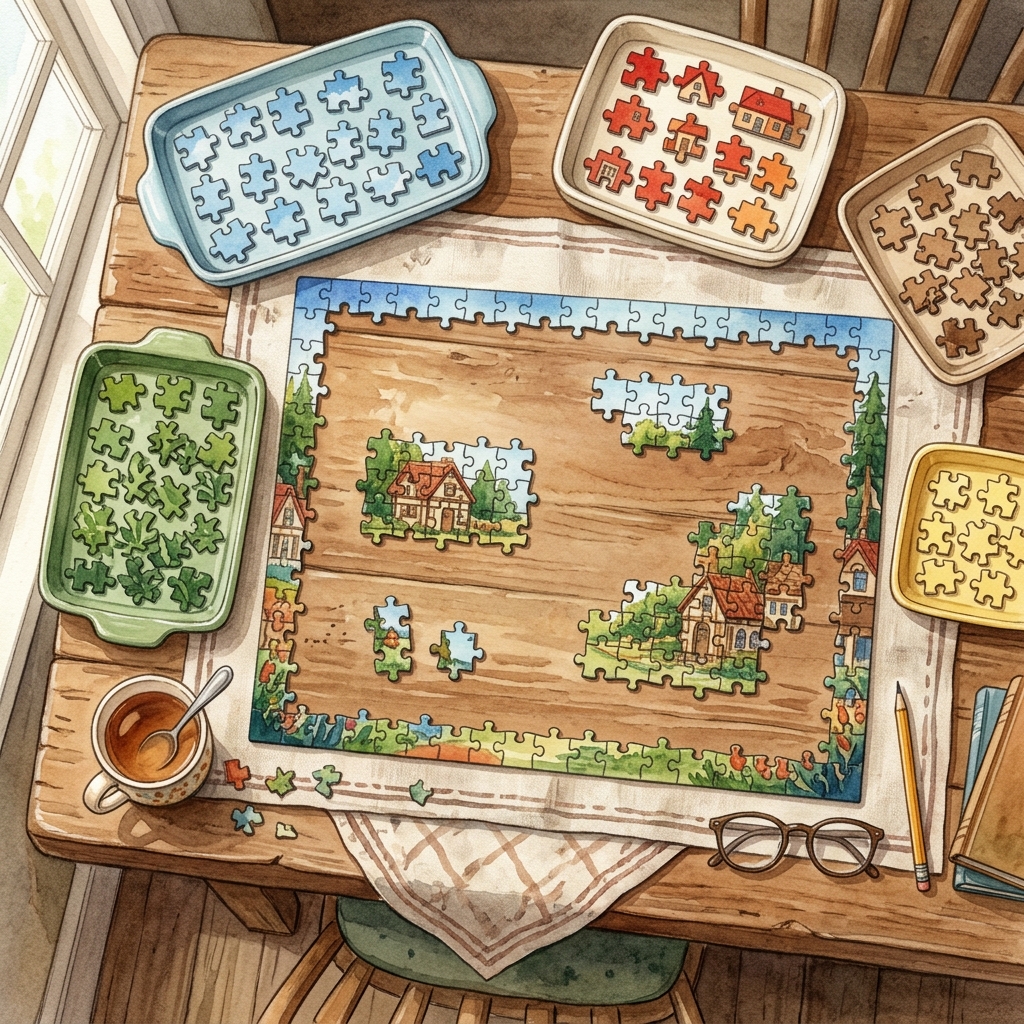
Whether you are preparing for a speed-puzzling competition or simply want to assemble a large board on a quiet Sunday afternoon without getting frustrated, using a structured strategy makes a significant difference.
Solving a jigsaw puzzle is not just a game of trial and error; it is a complex cognitive process of pattern recognition, spatial orientation, and sorting efficiency. By applying the same methodologies used by competitive speed puzzlers, you can double your assembly speed and enjoy a smoother, more satisfying experience. If you are interested in the competitive scene, check out our guide on the rise of speed puzzling to learn how speed puzzling tournaments work.
Here are the step-by-step techniques and strategies professionals use to complete puzzles rapidly.
1. Optimize Your Workspace and Lighting Setup
Before you touch a single puzzle piece, you must establish an efficient physical or digital environment. Speed puzzling is highly dependent on visual processing speed, which is easily impaired by poor lighting or clutter.
- Adjust Your Lighting: Use bright, neutral-colored overhead lighting (preferably LED daylight bulbs) to prevent shadows. If you are playing digital puzzles online on https://playjigsaw.net, ensure your device's brightness is set comfortably and night shift filters are turned off, as warm color filters can distort subtle color gradients.
- Maximize Your Surface Area: Your workspace should be at least double the size of the completed puzzle. This gives you ample space to spread out sorted pieces in a single layer rather than stacking them.
- Utilize Sorting Trays: Organize your space using shallow trays. In a physical setup, cardboard trays work well; in digital setups, grouping folders or separate areas of your virtual board keeps your workspace clean.
2. Sort Edges vs. Inside Pieces (The Border-First Rule)
Should you always build the border of a jigsaw puzzle first?
Yes, building the border first is the most efficient strategy for almost all standard puzzles. Constructing the frame establishes the outer boundaries of the board, provides structural reference points, and instantly reduces the remaining unsorted pool of pieces.
As you unbox or load your board, perform your first major sort:
- Extract the Border: Scan for pieces with at least one flat, straight edge.
- Corner Verification: Look specifically for the four corner pieces (two flat edges) and place them in their approximate positions.
- Assemble the Frame: Connect the flat pieces together immediately. This frame serves as an anchor. Every interior piece you place later can be measured and aligned against this boundary.
Note: The only exception is when a puzzle has a border of solid, identical color (like pure black or white). In those rare cases, it is faster to build the highly detailed interior elements first and attach the border last.
3. Categorize by Colors, Gradients, and Textures
Once the border is locked, sorting the remaining interior pieces is your most important speed multiplier. Never sift through a giant pile of mixed pieces looking for one specific spot.
- Distinct Color Blocks: Group highly contrasting, saturated colors together (e.g. separate sky blues, forest greens, and bright flower reds into different trays).
- Color Gradients: If you have a sky that transitions from orange to blue, organize the pieces in a line that mimics this transition. This dramatically narrows down your search pool for any given blank space.
- Distinct Textures and Patterns: Look for repeating lines or distinct textures, such as wood grain, brick walls, roof tiles, or striped clothing. These are often easier to identify than flat color regions.
- Landmarks and Text: Letters, signs, facial features (eyes, lips), and distinct high-contrast lines are high-priority landmarks. Assemble these first, as they are instantly recognizable.
4. Assemble "Islands of Detail" (Sub-Assemblies)
Do not try to build the puzzle by working outward from the border in a circular pattern. Instead, focus on building small, independent clusters—called sub-assemblies or "islands of detail."
Identify a highly specific object in the image, such as a single car, a window, or a distinct animal. Gather all pieces associated with that object and assemble it separate from the main frame. Once the cluster is assembled, slide it into its approximate position inside the frame.
As you build more islands, they will naturally connect to each other and to the outer border, rapidly filling in the blank spaces.
5. Transition to Shape Sorting (The Endgame Strategy)
When you reach sections of uniform color (such as a vast cloudless sky, deep water, or dark foliage), color sorting becomes useless. This is where speed puzzlers transition to shape-based sorting:
- Tab and Blank Alignment: Sort pieces by their physical configuration:
- Four-Tab (all male)
- Three-Tab, One-Blank
- Two-Tab, Two-Blank (Adjacent or Opposite)
- One-Tab, Three-Blank
- Four-Blank (all female)
- The Row Alignment Technique: Place all pieces of a single shape category in neat, parallel rows, oriented in the same direction. When searching for a piece to fit a gap that requires a specific tab shape, you can scan your rows systematically, saving minutes of trial-and-error matching.
Puzzle Assembly Order Guide
Competitive speed puzzlers adjust their assembly sequence based on the style of the puzzle artwork. Use this table to plan your attack:
| Puzzle Style | Primary Strategy | Secondary Strategy | Sorting Priority |
|---|---|---|---|
| Landscapes | Color Gradients | Texture Matching | Sky/Water first, foliage last |
| Art & Watercolor | Brush Stroke Patterns | Shape Alignment | Outline boundaries & landmarks |
| Mechanical/Vehicles | High-Contrast Outlines | Color Sorting | Metal edges and highlights |
| Pattern/Collage | Sub-assembly Islands | Grid Alignment | Text, icons, and small objects |
Practice Your Speed Solving Today
Speed solving is a skill developed through consistent practice and pattern recognition. Start with smaller 36-piece boards to practice your speed-sorting, then scale up to 400-piece challenges once your visual scanning becomes faster.
- Try sorting metallic gradients and high-contrast paint lines with our vehicle jigsaw puzzles.
- Challenge your visual texture recognition by solving watercolor and canvas details in the art jigsaw puzzles collection.
Ready to Train Your Brain?
Experience the therapeutic focus of jigsaw puzzles. Play our curated daily boards or upload your own photo instantly.