The Cognitive Science of Pattern Recognition in Puzzle Solving
Explore the neurological mechanisms behind pattern recognition, how the brain solves visual jigsaw puzzles, and Gestalt principles of perception.
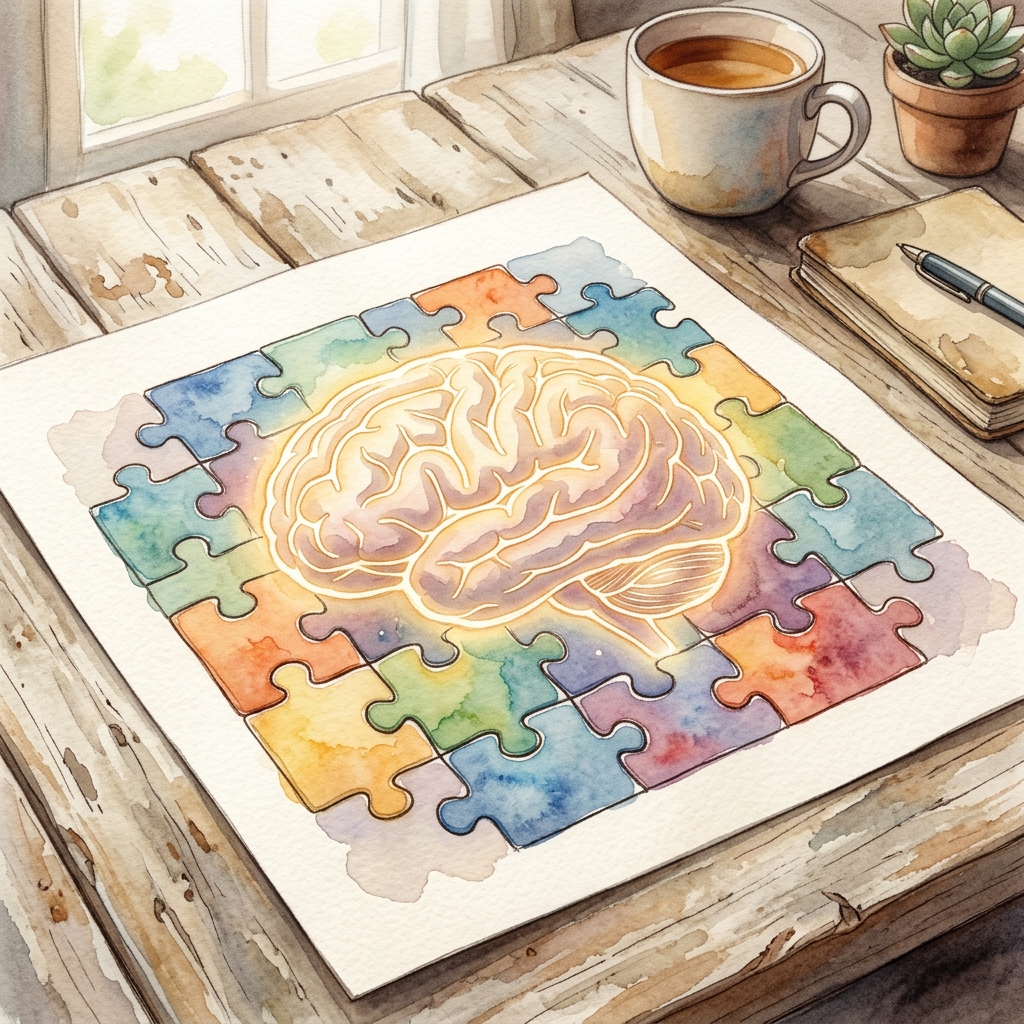
Human beings are, at their core, pattern-recognition machines. From recognizing faces in a crowd to predicting stock market trends, our survival and success depend on our ability to identify structures, colors, and repeating textures in a chaotic environment.
But what actually happens in the brain when we engage in a highly visual task like solving a jigsaw puzzle?
Neurology and cognitive psychology show that puzzling is not just a leisure activity; it is a complex cognitive workout. It activates advanced visual processing networks and relies heavily on classical principles of perception. By understanding the science behind how your brain processes visual information on platforms like PlayJigsaw, you can sharpen your mind and improve your problem-solving efficiency in everyday life.
1. The Neural Pathway of Visual Processing
When you look at a scattered pile of puzzle pieces, your eyes send raw electrical signals to the primary visual cortex (V1) at the back of your brain. From there, the brain splits the workload into two major processing streams, often called the "What" and "Where" pathways:
- The Ventral Stream (The "What" Pathway): Travels down to the temporal lobe. It is responsible for identifying objects, colors, textures, and shapes. This pathway helps you recognize that a piece contains a brush stroke, a flower petal, or a distinct line.
- The Dorsal Stream (The "Where" Pathway): Travels up to the parietal lobe. It handles spatial awareness and rotation. This pathway allows you to mentally rotate a piece and determine how its shape matches a gap on the board.
Solving a jigsaw puzzle forces these two pathways to communicate rapidly. The constant feedback loop between identifying a piece's detail ("What") and placing it in space ("Where") builds stronger neural connections, enhancing overall cognitive agility.
2. Gestalt Principles: How the Brain Groups Visual Clues
What is Gestalt psychology and how does it apply to puzzles?
Gestalt psychology is a school of thought suggesting that the human mind naturally groups individual elements to perceive a unified whole. When solving puzzles, your brain constantly relies on Gestalt principles—such as similarity, proximity, and closure—to categorize pieces and predict where they fit.
Here are the key Gestalt principles that guide your brain during puzzle-solving:
- Similarity: The brain groups elements that look similar. When you group all pieces with a wooden texture or sky-blue color, you are utilizing this principle to organize your workspace.
- Proximity: The brain groups elements that are close to one another. You naturally place pieces with similar colors near their approximate positions on the board.
- Closure: The human mind hates incomplete shapes. When you see a gap in a circular flower layout, your brain projects the missing curve, allowing you to search the pile for a piece that completes the circle.
- Continuity: The eye seeks smooth, continuous lines. Your brain easily tracks lines like a road, a tree branch, or the edge of a building across multiple pieces, letting you align them rapidly.
3. Working Memory and Visual Chunking
Your short-term working memory has a limited capacity. On average, the human mind can only hold about 4 to 7 items of information at once. To solve a complex 400-piece board without getting overwhelmed, the brain uses a cognitive strategy called visual chunking.
Visual chunking is the process of grouping individual pieces of data into larger, memorable units. Instead of trying to memorize the shapes of 50 individual sky pieces, your brain groups them into "light blue sky," "dark blue sky," and "cloud edges."
By reducing the cognitive load on your working memory, chunking allows you to process visual information faster and solve puzzles with greater ease.
4. The Chemistry of the "Aha!" Moment
When you search for a matching piece for minutes and finally snap it into place, you experience a sudden burst of satisfaction. In cognitive psychology, this is known as the Insight Moment or the "Aha!" phenomenon.
At the exact moment of connection, your brain releases a small surge of dopamine. This neurotransmitter regulates pleasure, learning, and motivation.
This chemical reward loop reinforces cognitive focus. It trains your brain to enjoy solving complex problems, building persistence and focus that carries over into your professional and academic tasks.
Cognitive Load: Passive Scrolling vs. Active Pattern Matching
To understand why active pattern recognition is so healthy, compare its cognitive effects against passive screen consumption:
| Metric | Passive Media Consumption (Scrolling/Watching) | Active Pattern Recognition (Puzzles) |
|---|---|---|
| Brain Processing Mode | Reactive (automatic visual tracking) | Proactive (active hypothesis testing) |
| Visual Stream Utility | Low (flat tracking) | High (Ventral & Dorsal stream synthesis) |
| Working Memory Load | Extremely low (high distraction) | Moderate (sustained visual chunking) |
| Neural Plasticity | Static | Stimulates dendritic growth |
| Dopamine Release | Erratic, quick spikes (addictive) | Slow, reward-driven satisfaction |
How to Train Your Brain's Pattern Recognition
You can actively improve your visual-spatial reasoning and pattern matching by choosing puzzles that challenge specific areas of the brain:
- To Train Texture and Brush Stroke Recognition: Solve detailed art boards. Analyzing fine paint details in art jigsaw puzzles challenges the ventral stream to identify microscopic visual clues.
- To Train Color Gradient Parsing: Solve expansive landscape scenes. Sorting subtle transitions from green trees to blue mountains in landscape jigsaw puzzles trains your eye to detect tiny changes in color saturation.
- To Train Shape Rotations: Practice solving solid-color sections by organizing pieces in rows based on their tabs and blanks. This forces the dorsal stream to handle geometric alignments without relying on color details.
Ready to Train Your Brain?
Experience the therapeutic focus of jigsaw puzzles. Play our curated daily boards or upload your own photo instantly.