The Rise of Speed Puzzling: How to Get Started in Competitive Jigsaw Solving
Discover the fast-growing world of competitive speed puzzling. Learn essential pro techniques, training strategies, and how to practice using digital puzzle boards.
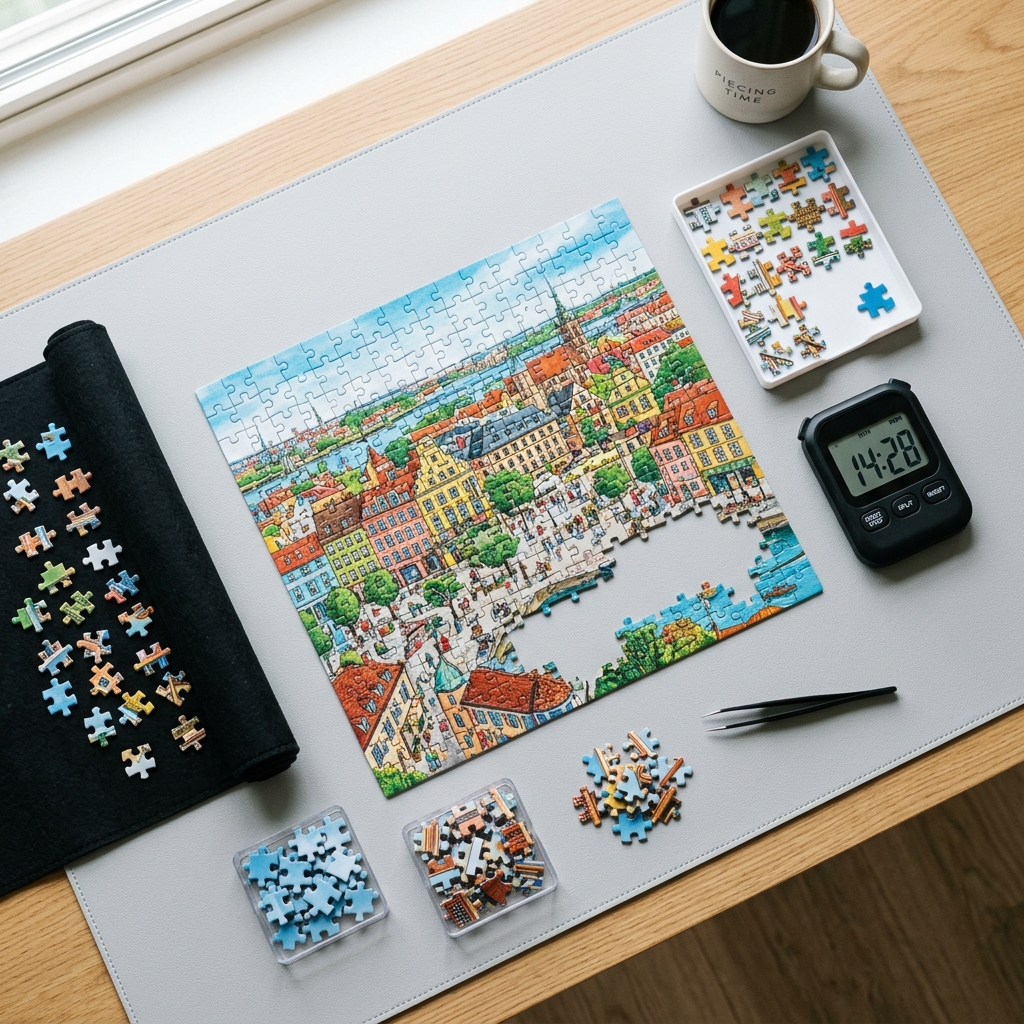
In recent years, a classic, quiet pastime has transformed into an adrenaline-fueled competitive sport. Speed puzzling—the art of assembling jigsaw puzzles as quickly as possible—has taken the internet and communities worldwide by storm. From viral TikTok challenges showing competitors assembling 500-piece puzzles in under 30 minutes to the packed halls of the World Jigsaw Puzzle Championship in Spain, competitive puzzling is now a recognized global phenomenon.
If you are a casual puzzle solver who loves the satisfying snap of matching pieces, practicing on a free online platform like PlayJigsaw is an exciting way to test your cognitive limits. However, competitive puzzling is not just about moving your hands faster; it is a game of high-level pattern recognition, visual-spatial strategy, and refined ergonomics.
This comprehensive guide breaks down the science of speed puzzling, examines the strategies used by world-class competitors, and outlines how you can start training today.
What is Speed Puzzling?
At its core, speed puzzling is a timed competition where individuals, pairs, or teams of four race to complete identical jigsaw puzzles.
- Individual Divisions: Typically feature a single player assembling a standard 500-piece puzzle. Top competitors regularly finish in under 35 minutes—a task that takes the average person three to four hours.
- Pairs and Teams: Involve multiple players working on a single board, sometimes scaling up to 1,000 or 1,500 pieces. This format requires flawless non-verbal communication and distinct zone management.
The sport is governed internationally by the World Jigsaw Puzzle Federation (WJPF), which hosts annual world championships attracting solvers from over 50 countries. The growth of the sport has been accelerated by online platforms, where remote competitions and global leaderboards allow enthusiasts to compete asynchronously from their own homes.
The Anatomy of a Speed Puzzler’s Strategy
Casual solvers usually dump all the pieces on a table, slowly turn them face up, and hunt for the border. In a competition, this passive approach is a recipe for defeat. Speed puzzling requires active, parallel processing. Here is the step-by-step methodology used by elite racers:
1. The Active Sort (The "Flipping" Phase)
The clock starts the moment you open the box. Your first task is to get all pieces out and face-up.
- Don't Over-Sort: Casual players waste minutes sorting pieces into detailed piles (edges, sky, grass, etc.). Pros perform a "rough sort" while flipping pieces. They organize pieces by major color blocks and textures in broad sections of their workspace, leaving secondary sorting for later.
- Two-Handed Flipping: Practice using both hands independently. Your left hand should grab and flip pieces in one section, while your right hand does the same in another, minimizing empty movements.
2. The Border Debate: To Build or Not to Build?
In casual play, building the frame first is a golden rule. In speed puzzling, it depends entirely on the puzzle design:
- The Traditional Approach: If the border has high contrast and distinct lines, build it first. It defines your boundaries and reduces the search area.
- The Inward-Out Strategy: If the border is a uniform color (e.g., solid black, white, or sky), skip the border. Top speed puzzlers will focus on highly detailed central landmarks (like a brightly colored building or a distinct character) and build outward. Searching for 100 identical border pieces at the start wastes valuable momentum.
3. Visual Chunking and Color Gradients
Instead of looking at the reference image constantly, speed solvers focus on the pieces. They use a cognitive skill called visual chunking—grouping pieces by tiny details like line directions, text, gradients, and brushstroke textures.
- Scan for "Landmarks": Look for text, eyes, sharp transitions of color, or geometric shapes. These are "anchors" that can be assembled instantly without looking at the box.
- Gradient Mapping: If a section has a gradient (e.g., transitioning from orange to yellow), sort the pieces in a line representing that gradient. This allows you to visually predict where a piece sits along the spectrum.
4. Reading the "Knobs" and "Holes" (Shape Recognition)
When colors and gradients fail, you must rely on pure geometry. Jigsaw pieces have distinct anatomical parts: knobs (tabs) and holes (blanks).
- Sort by Shape Orientation: Sort difficult, monochrome sections by the number of knobs and holes (e.g., 2-knob/2-hole pieces, 3-knob/1-hole, or all-knob).
- The Grid Match: When looking for a piece to fit a specific spot, analyze the empty space. Does it need a vertical piece with two opposite knobs? By filtering your visual search to only matches of that exact geometry, you ignore 80% of the pieces on the board.
Physical Setup and Workspace Ergonomics
Speed puzzling is physically demanding. Leaning over a flat table for hours can cause neck strain and fatigue, which directly slows down your reaction times.
| Setup Element | Casual Setup | Speed Puzzler Setup |
|---|---|---|
| Table Surface | Standard dining table (flat) | Slightly tilted board (15–20 degrees) to reduce glare and neck strain |
| Lighting | Warm ambient room light | 1000+ lumen daylight LED, positioned to eliminate shadows |
| Piece Sorting | Scattered around the board | Stackable shallow sorting trays, arranged by color |
| Posture | Slouched, sitting down | Active standing or high ergonomic stool for better reach |
How to Train for Speed Puzzling Online
You do not need to buy dozens of physical boxes to practice. In fact, practicing digitally is one of the most efficient ways to build your pattern recognition skills. Digital platforms eliminate cleanup time, allowing you to run back-to-back training sessions.
Here is how you can use digital puzzle boards to build competitive speed:
- Start with Smaller Grids: Practice on 36-piece and 144-piece digital boards to master rapid shape matching and visual scanning without feeling overwhelmed.
- Use Daily Challenges: A key element of speed puzzling is adapting to unfamiliar images. Playing a daily online puzzle challenge forces you to solve a brand-new image every morning under time pressure, training your adaptability.
- Track Your Progress: Compare your completion times against others on a global leaderboard. Watching your ranking improve provides the necessary feedback loop to refine your speed.
- Practice High-Contrast Images: Start with high-detail illustrations (like cartoon art) which are easier to chunk, then progress to difficult gradients (like landscapes or sky).
For a deeper dive into the specific physical hand-eye coordination techniques and sorting patterns, read our comprehensive strategy guide on how to solve jigsaw puzzles fast.
Step Up to the Board
Speed puzzling is a beautiful fusion of mental focus and physical execution. By moving away from passive sorting, learning to read piece anatomy, and optimizing your training environment, you can shave minutes off your personal records.
Ready to test your speed? Head over to today's daily challenge, start the timer, and see how you match up against the community!
Ready to Train Your Brain?
Experience the therapeutic focus of jigsaw puzzles. Play our curated daily boards or upload your own photo instantly.